

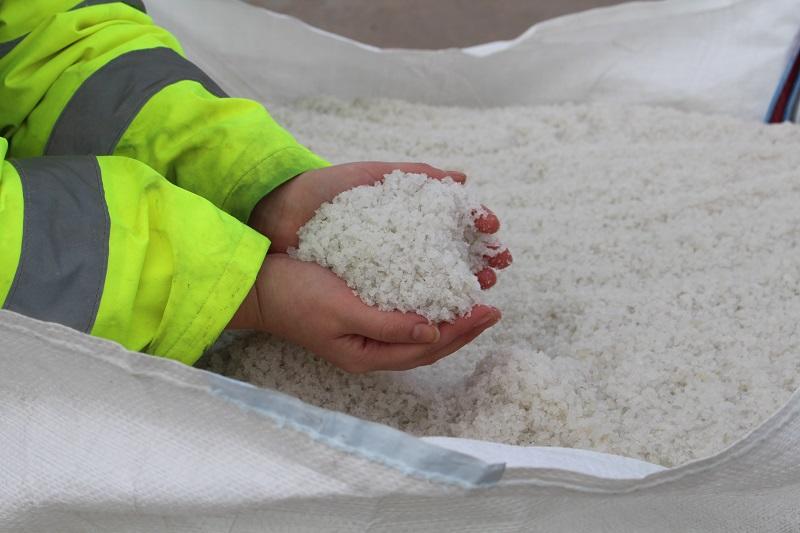
In colder places, when winter grips roads, walkways, and driveways more tightly than ever before, proper snow and ice management becomes important. White deicing salt is an essential weapon in the fight against slick surfaces, among other methods used to overcome hazardous winter conditions. In the dead of winter, this seemingly little chemical is essential for keeping roads and pavements safe for pedestrians and drivers alike.
A mainstay of winter maintenance for decades, white deicing salt is mostly sodium chloride. Road crews, property managers, and homeowners all rely on it because of how well it reduces the freezing point of water. White deicing salt is a refined and purified version of rock salt that is both more aesthetically pleasing and may be less damaging to infrastructure and plants than its more prevalent cousin.
Fundamental chemical principles form the basis of the science underlying white deicing salt’s efficacy. Applying salt to ice or snow causes it to dissolve and create a brine solution. Even at temperatures lower than the typical freezing point of water, the ice will melt because this saltwater mix has a lower freezing point than pure water. Spreading saltwater eventually seeps under the ice and dissolves it, exposing the underlying pavement or concrete. White deicing salt is a reactive and proactive defence against winter risks because it dissolves existing ice and helps prevent new ice from developing.
The purity of white deicing salt is a major benefit over other types of salt. Refined rock salt is less likely to be a surface cleaner since it has had many of the impurities it originally contained removed. White deicing salt is a popular choice for regions that prioritise aesthetics, such high-end residential homes, retail spaces, and office complexes. Because of its pure white colour, the salt can be used more precisely because its application spots are more noticeable.
To get the most out of white deicing salt and avoid any unwanted side effects, you have to think about how to apply it carefully. Applying the salt in the days leading up to a winter storm will keep the ice from sticking to the surface and will make its removal much easier in the case of a storm. It may be required to reapply the salt often during continuous precipitation in order to keep it effective. Warning: in very low temperatures, usually below 15°F (-9°C), white deicing salt, like with all chloride-based deicers, loses most of its effectiveness. It may be necessary to use additional deicing products or processes in addition to or instead of salt in such situations.
There are certain downsides to using white deicing salt, notwithstanding its effectiveness in melting ice and snow. The possibility for negative effects on the environment is a major worry about its use. The dissolution of salt has the ability to impact both terrestrial and aquatic ecosystems through runoff into adjacent soil and water systems. Soil chloride may change soil chemistry and harm plants when it builds up in the soil. Many cities and property managers are implementing measures to reduce salt use in an effort to lessen these impacts. These include pre-wetting the salt to make it stick better to surfaces and employing precision applicators to limit how much salt is dispersed.
The possible effects on infrastructure are another factor to think about while using white deicing salt. Vehicles, bridges, and concrete reinforcement steel are all susceptible to rapid corrosion from the chloride in salt. Some infrastructure in places with significant salt use has had its lifespan reduced and maintenance expenses increased as a result. Some areas are looking at other ways to de-ice or are utilising corrosion inhibitors with salt to solve this problem.
Regardless of these concerns, white deicing salt is often preferred due to its many advantages, especially in terms of public safety. White deicing salt, when used correctly, may greatly lessen the likelihood of car accidents and slip-and-fall incidents that occur during winter weather. By lowering accident-related expenses and keeping production high during winter, this not only saves lives but also provides significant economic advantages.
With millions of tonnes used every year in cold-climate locations around the globe, the manufacturing and distribution of white deicing salt constitute a sizable business. The salt is usually extracted from aquifers or ponds that collect water evaporated by the sun. The white, crystalline deicing salt is made from refined and processed raw salt that has had impurities removed. Although white deicing salt is more expensive than rock salt because of the refining process, many consumers believe that the product’s better performance and less negative affects are worth the extra cost.
An increasing number of people are looking for greener alternatives to the conventional white deicing salt in recent years. Agricultural by-products like beetroot juice and maize steepwater are sources of organic chemicals that can be used as substitutes. To increase salt’s efficacy and decrease chloride emissions, these compounds can be used in conjunction with salt. Although these alternatives show promise, they still cost more than regular salt and might not work in every situation.
Better application methods and technology are another strategy to lessen white deicing salt’s ecological footprint. More accurate scheduling of salt applications is made possible by advanced weather forecasting systems, which reduces waste and improves efficacy. Salt spreaders directed by GPS can cover the area evenly and not apply too much, and pre-wetting systems let the salt stick to surfaces better, so there’s less bounce and dispersion.
Training and education for those who apply salt has also grown in significance over the past few years. Professionals in winter maintenance may now enrol in certification programs that educate them how to apply and handle salt properly. Knowledge of the many forms of winter precipitation, how much salt to apply in different situations, and how to correctly calibrate equipment are all topics covered in these seminars. We can obtain greater outcomes with less environmental effect if people responsible for using white deicing salt improve their skills and knowledge.
Changes to global weather patterns brought on by climate change may need new approaches to using white deicing salt. The need for deicing products may rise in areas where freeze-thaw cycles are happening more often. On the other hand, certain regions can see less snowfall but more ice occurrences, necessitating other strategies for winter maintenance. Research and innovation in deicing technology and methods will need to be ongoing in order to adapt to these shifting conditions.
More advanced mixing with other materials to provide bespoke deicing solutions for certain situations or habitats may also be in store for white deicing salt in the future. Salt mixed with sand or gravel, for instance, can improve traction and melt more quickly, and salt mixed with corrosion inhibitors can shield infrastructure from damage. More customised and long-term deicing solutions could be on the horizon as our knowledge of the interplay between deicing substances, ecosystems, and infrastructure expands.
Finally, white deicing salt is still an important ingredient in winter storm management and public safety. Its sleek look, relative ease of use, and efficacy in melting ice and snow make it a popular choice for a wide range of applications. Nevertheless, there are environmental and infrastructure concerns associated with white deicing salt use that need careful management. White deicing salt will certainly continue to be a subject of continuous research, innovation, and controversy as we strive to find a balance between winter maintenance safety, environmental responsibility, and cost-effectiveness. We can make sure that winters for generations to come are safer by following best practices, looking for alternatives, and always getting better at using white deicing salt. That way, we can get the most out of it without wasting it.