
Modern vehicle security represents a delicate balance between impenetrable theft prevention and driver accessibility. While modern immobilisers, cryptographic rolling codes, and deadlocking mechanisms have drastically reduced opportunist car theft across the United Kingdom, they have also fundamentally changed what happens when something goes amiss. A locked door, a snapped blade, or a desynchronised transponder can instantly immobilise a journey, leaving the motorist stranded in an environment that may be neither convenient nor secure.
Because no two vehicle lockout or key failure incidents unfold under identical conditions, the response required from a qualified emergency car locksmith must be exceptionally versatile. The technical methodology suitable for recovering keys resting on the parcel shelf of an executive saloon in a well-lit driveway is entirely unsuited to resolving a complete transponder erasure on a commercial panel van halted on an unlit rural carriageway. Professional resolution relies on an immediate assessment of the vehicle’s proprietary security tier, the physical location, and the functional state of the underlying electronics.
Navigating Diverse Mechanical and Electronic Architectures
Automotive lock mechanisms vary substantially across manufacturers, generations, and vehicle classifications. A seasoned technician does not simply approach a door with generic bypass tools; they must adapt their approach to the specific mechanical architecture fitted to that exact chassis. High-security laser-cut tracks, internal wave cuts, and traditional double-sided edge keys each demand dedicated manipulation picks, decoders, and tension tools to achieve clean, non-destructive entry.
Beyond the physical barrel lies the electronic environment. German, French, Asian, and British marques deploy distinct protocols for transponder handshake routines, central locking control units, and engine control units (ECUs). When a key fails to communicate, the solution must pivot depending on whether the system uses a fixed-code transponder, an encrypted rolling-code chip, or an advanced passive keyless go system. Specialist diagnostics must read the precise security data directly from the on-board diagnostics (OBD) port, or in certain sophisticated instances, directly via bench programming from the body control module, ensuring the vehicle accepts the replacement key without corrupting existing module parameters.
Managing Non-Destructive Entry
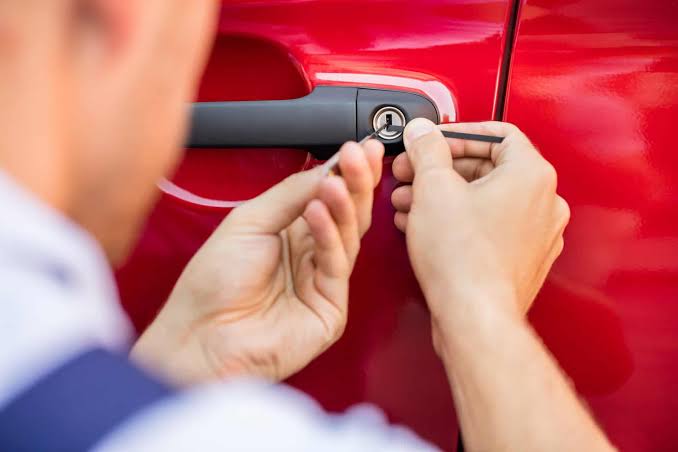
Preserving the aesthetic and mechanical integrity of the car is paramount. In situations where keys are locked inside the passenger cabin or luggage compartment, picking the lock barrel directly using precision instruments—such as vehicle-specific Lishi decoders—allows access without scratching paintwork, stretching door seals, or fracturing glass. This methodology reads the exact position of internal wafers, permitting the technician to decode the mechanical cut while unlocking the vehicle simultaneously.
The Influence of Physical Environment on Roadside Work
One of the most defining aspects of roadside assistance is the immediate environment. Motorists rarely experience key failures in convenient workshop conditions; instead, emergencies arise in tight subterranean multi-storey car parks, exposed motorway service areas, busy urban red routes, or secluded country lanes across London, Surrey, Sussex, and Kent.
In low-clearance underground facilities, conventional flatbed recovery vehicles are physically incapable of entering to hoist a stranded car. In these confined spaces, an automotive locksmith operates as a self-contained mobile workshop. With compact computerised key-cutting units, independent auxiliary power systems, and diagnostic computers transported directly to the vehicle bay, the problem can be diagnosed, the blade milled, and the transponder paired entirely on site, eliminating the complex logistics and elevated costs of secondary extraction.
Conversely, roadside verges present distinct safety and visibility requirements. Here, speed of deployment, rigorous safety precautions, and precise execution become vital. Technicians must swiftly read security data, cut new key profiles, and program electronic fobs while keeping the vehicle secure and enabling the driver to resume their travel with minimal delay.
Adapting to Complete Key Loss Versus Secondary Failures
The technical protocol changes fundamentally depending on whether a spare key exists elsewhere or if the driver faces an all-keys-lost scenario. When an existing key is merely locked inside, non-destructive opening resolves the dilemma within minutes. However, total key loss requires a multi-stage engineering response performed entirely from scratch.
In total loss situations, the locksmith must first determine the mechanical key code. This can sometimes be retrieved via manufacturer databases using the Vehicle Identification Number (VIN) or deduced mechanically by reading the physical wafers inside the door lock barrel. Once the mechanical key profile is verified, modern CNC key-cutting equipment accurately cuts a fresh blade to factory tolerances. The subsequent stage requires pairing the new transponder chip with the immobiliser, a process that frequently requires clearing lost keys from the vehicle’s internal memory to ensure that misplaced or stolen keys can no longer start the engine.
Addressing Mechanical Ignition Failures
Not every failure is electronic or related to forgotten keys. Mechanical wear within the ignition barrel itself poses a distinct challenge, particularly in high-mileage fleet cars or light commercial vehicles. Internal wafers can collapse, stick, or deform, preventing the key from turning to the accessory or ignition position.
Rather than replacing the entire steering column assembly at considerable dealership expense, an adaptable mobile response involves disassembling the faulty barrel, extracting sheared components or worn wafers, and rebuilding or replacing the cylinder to match the original key pattern. This tailored mechanical repair restores starting capability while ensuring the driver retains a single key that operates both the external door locks and the ignition.
Commercial Fleets and Time-Critical Applications
For sole traders, courier networks, and service fleets, a stranded vehicle represents more than a personal inconvenience; it immediately translates into cancelled delivery schedules, breached contracts, and idle workforce hours. Commercial vehicles often feature aftermarket security additions, including internal slam locks, high-security deadlocks, and specialised bulkhead barriers, which significantly raise the technical barrier for access.
Resolving access problems on a delivery van requires a methodology that accounts for these secondary security layers without damaging valuable cargo or breaching secondary door seals. Technicians carrying specialised software and hardware can cut commercial keys on the spot, code the fobs to operate factory remote central locking, and address issues with electronic steering locks (ESLs) that frequently fail on commercial transport platforms.
Electronic Module Diagnostics and Control Unit Coding
Automotive electronics have moved far beyond isolated central locking relays. In modern vehicles, security functions are deeply integrated across the Engine Control Unit (ECU), the Body Control Module (BCM), the instrument cluster, and electronic steering lock modules. A communication error within any of these units can mimic a physical key failure, causing the vehicle to reject an otherwise functional transponder.
Advanced automotive locksmiths utilise sophisticated diagnostic scanners and EEPROM programming capabilities to identify the root cause of starting failures. When communication protocols drop, the technician can reset the immobiliser loop, reprogram the control units, or install specialised electronic emulators where steering lock hardware has permanently seized. This level of on-site diagnostic depth ensures that motorists are not left stranded by complex software faults that would otherwise demand weeks of dealer investigation.
A Proactive Perspective on Automotive Access
While responsive roadside problem-solving is invaluable when unforeseen difficulties strike, understanding the complexity of modern vehicle security also highlights the value of preventative measures. Securing a programmed spare key while an original remains fully operational is universally simpler, quicker, and more economical than coordinating an all-keys-lost recovery from an awkward location.
Ultimately, the strength of modern automotive locksmithing lies in its responsiveness to unpredictable variables. By bringing diagnostic sophistication, high-precision mechanical cutting equipment, and marque-specific knowledge directly to the driver’s location, specialist technicians provide an indispensable, adaptable service that keeps vehicles moving forward safely and reliably across diverse environments.
Get in Touch:
247 Auto Locksmith Services LTD
United Kingdom
07921 365247
247autolocksmith.co.uk